NAB Show 2026: The Themes That Shaped This Year’s Event
Drawing on perspectives from Lumine Group’s Corporate Development and M&A teams, this article examines the themes that shaped NAB Show 2026: AI in production workflows, software performance in platform environments, hybrid cloud virtualization, and the evolution of live production. Together, these themes reflect an industry that has shifted from exploring what’s possible to delivering on it consistently.
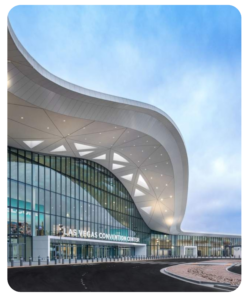
When the Las Vegas Convention Center completed its multi-year, $600 million renovation earlier this year, it quietly mirrored what much of the media and broadcast software industry is experiencing now. With the core capabilities now in place, we’ve entered an evolution phase – shifting focus from building and experimentation to operating reliably at scale, under real-world conditions.
With this year’s NAB Show underway, the media and broadcast software industry feels firmly past experimentation. The focus has shifted to execution, making existing technologies reliable, scalable, and sustainable in real operating environments.
AI, streaming, and hybrid broadcast models are no longer emerging ideas. They are established parts of daily decision‑making. Going into this year’s show, the shift will be on how the industry is approaching them: with greater scrutiny on what integrates cleanly, scales with confidence, and evolves without disrupting revenue or workflows.
This article explores how that shift from experimentation to execution, reliability, and scale – is shaping the themes of this year’s show.
Interested in speaking with our Corporate Development team?
Meet Us at the NAB Show 2026
Software Performance in a Platform World
NAB has highlighted how media companies continue to evolve into platform operators. But with that comes an underlying challenge, most platforms are not rebuilding from scratch. Linear, streaming, and digital workflows now coexist by default, layered over time through incremental change. The result is not a clean architectural reset, but a more complex operating environment where systems need to work across formats, business models, and distribution channels simultaneously.
That shift is creating a more defined role for software. Increasingly, it’s software that determines how well linear and digital solutions perform in practice, whether workflows connect, where friction accumulates, and how efficiently content moves from creation to monetization.
For media software companies, this presents a clear opportunity. As complexity increases, software products that can operate across mixed environments—integrating with existing systems, supporting multiple workflows, and continuing to perform as requirements evolve—become more central to their customers’ operations. In many cases, they are where media platform strategies either succeed or stall.

NAB highlights those dynamics. As Arjan Stroomberg, SVP and Head of M&A at Lumine Group, notes:
“The conversations happening across the media software industry right now tell a clear story. Founders and operators are navigating the same structural shifts — supporting linear and streaming workflows, adapting to new monetization models, and integrating into increasingly complex environments. What becomes clear is that performance isn’t about a single feature or architecture choice. It’s about how software holds up over time — how it integrates, how it adapts, and whether it continues to deliver value as those environments evolve.”
From that vantage point, differentiation becomes more observable. Software that accommodates complexity not just requiring it to be simplified, tends to remain embedded as customer environments evolve. And as platform models continue to take shape, that ability to operate across change is increasingly what defines long-term relevance.
Cloud Virtualization
This year NAB has taken the topic of cloud virtualization and presenting it as a practical response to mounting cost pressure and operational complexity. For broadcasters and media organizations, the emphasis is on applying cloud and virtualization to simplify how software is deployed and operated, while enabling distributed workflows across production, storage, analytics, and security.
That framing matters for media and content software companies. The conversation has shifted away from where workloads run and toward how software behaves as operating environments become more mixed. Rather than full-scale migration, the priority is flexibility: supporting hybrid setups where on-prem, virtualized, and cloud environments coexist by default.
As a result, software is being evaluated differently. Customers aren’t asking whether a platform is “cloud native” in the abstract. They’re asking whether it operates consistently across hybrid environments, scales selectively without driving up cost, and integrates cleanly into workflows that are only partially virtualized.

Connor Ennis, Senior Director of Corporate Development at Lumine Group returns to NAB Show this year with this perspective:
“What comes through most clearly at NAB is that cloud isn’t being discussed as an end state anymore, teams want to understand how software behaves across hybrid environments, and whether it gives them flexibility without introducing new operational risk.”
For founders, the takeaway is increasingly concrete. Cloud readiness is no longer a positioning statement. It shows up in how easily software fits into existing environments, how predictable it is to operate, and how well it supports change without constant re-architecture. Products built around a single deployment model often struggle as customers balance cost control with modernization. Software designed for portability, configurability, and long-term operability is better positioned to endure.
Those are the characteristics Lumine looks for when engaging with media and content software businesses navigating this phase of cloud adoption.
Live Production – Broadcast Must Adapt to Hybrid Operations
One of the more telling shifts ahead of NAB is how live production is being discussed. Industry coverage points to a hybrid reality, where broadcasters are combining IP, on-prem systems, and cloud resources into unified workflows, seeking greater flexibility without compromising the reliability live environments demand.
That framing reflects a practical truth. Broadcasters want to modernize without abandoning existing investments, aligning broadcast grade performance with incremental operational change. Fully virtualized production stacks aren’t the expectation. Software that can coexist with legacy systems and support gradual adoption is.
For media and content software companies, this has direct implications. Customers are looking for products that operate cleanly across mixed environments, integrate into established live workflows, and add value without introducing risk or disruption – especially where timing, performance, and reliability matter every day.

Quinten Larmand, Manager of Corporate Development for the Americas at Lumine Group, sees this clearly in conversations with founders at NAB.
“In live production, most teams aren’t trying to replace everything at once,” Quinten says. “They’re focused on how software fits into hybrid environments – where it can add value incrementally while remaining reliable under real production conditions.”
For founders, the takeaway is practical. Success in live production software comes less from architectural purity and more from supporting how customers operate today. Products that are flexible, interoperable, and reliable across mixed environments are better positioned to scale as standards mature and comfort with IP continues to grow. That ability to support hybrid live production consistently over time is a great signal they’re working where the industry is headed when engaging with businesses in this space.
Artificial Intelligence: From Demonstration to Deployment
This year, the conversation around artificial intelligence has narrowed in a noticeable way. AI is no longer treated as a showcase feature working on one thing. Instead, it’s being evaluated based on how it performs when embedded directly into production, distribution, and monetization workflows.
The earlier wave of experimentation established a baseline: AI could generate content, automate tasks, and surface insights. It also exposed the trade-offs: tools that performed well in controlled environments often introduced rework, exceptions or additional oversights, offsetting any efficiency gains.
What’s changed is where value is showing up. More agentic approaches are now executing multi‑step workflows with limited supervision and combined with growing pressure on media organizations to improve efficiency without increasing headcount or risk. In that environment, AI is being measured against concrete outcomes: cycle time reductions, higher metadata accuracy, improved content utilization, and incremental revenue lift tied to personalization and targeting.

This aligns closely with what Elliot Yunger, SVP of Corporate Development at Lumine Group, is seeing across the media software landscape.
“AI has been part of this industry for a long-time, but the evaluation criteria has changed. Teams are looking at how models perform under production conditions, whether they reduce cycle times, improve accuracy, and operate reliably within existing workflows. The impact is showing up in measurable ways: faster turnaround, better content utilization, and revenue gains tied to more precise targeting and personalization. At the same time, governance has become a gating factor. If teams can’t audit outputs or trust how decisions are made, deployment stalls. The companies seeing consistent results are the ones treating AI as a foundational part of their software. Designed to perform predictably, integrate cleanly, and hold up at scale.”
For founders, the implication is practical. AI that reduces friction inside core workflows, can be governed over time, and supports scale without constant intervention tends to strengthen a product’s long‑term relevance.
Looking forward to seeing you at NAB Show 2026
NAB is where content comes to life. It’s also one of the best pulse checks on how the technology and software behind the media industry are evolving. Each year, it brings together the builders, operators, and decision‑makers shaping how media is created, managed, and delivered in practice.
Our portfolio companies will be at the show, including WideOrbit, who will be exhibiting and sponsoring the event.
Velocix, Vidispine and TransMedia Dynamics will also be active at the show.
If you’ll be in Las Vegas, our Corporate Development team members are available to connect.